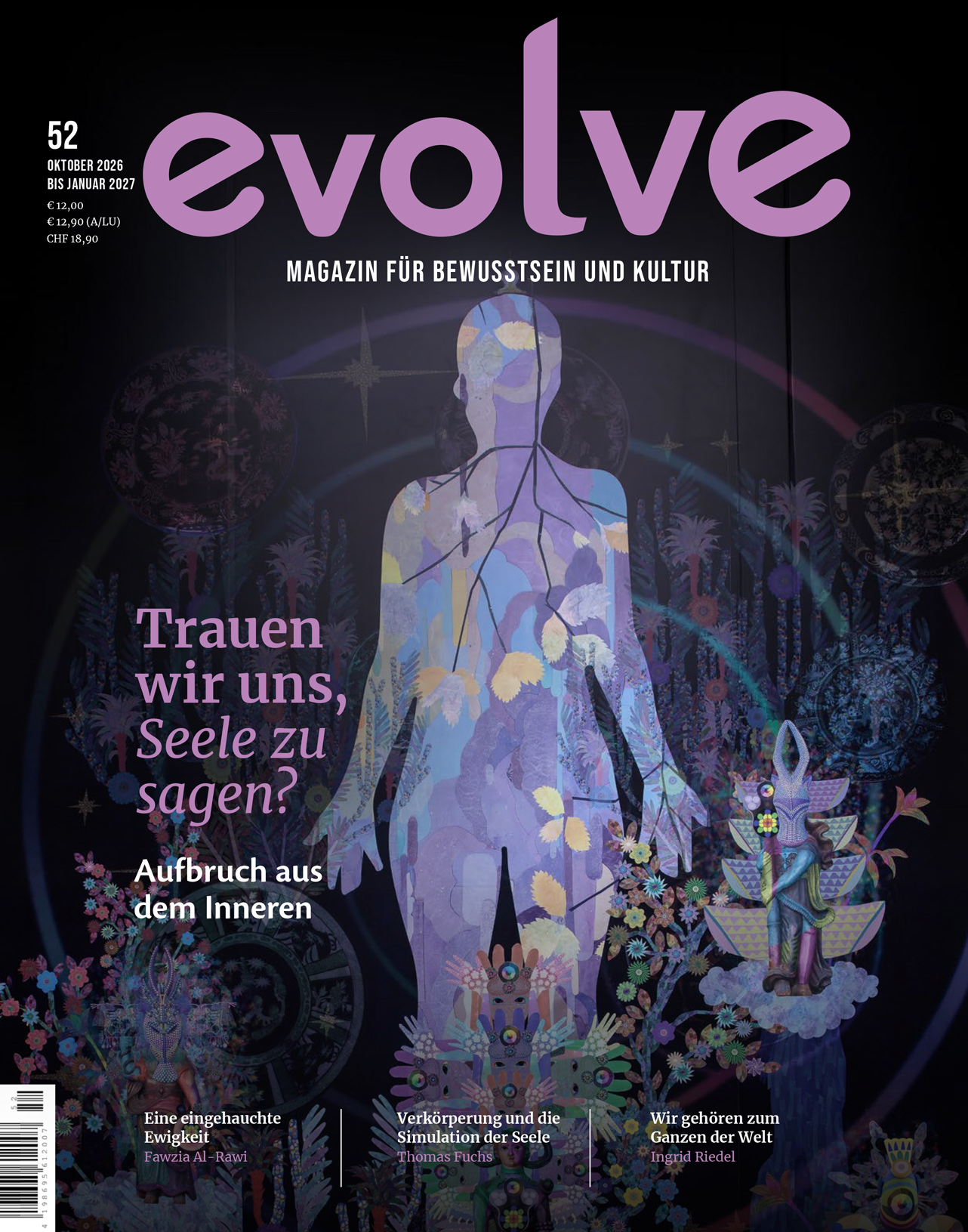
The Threshold to a Possible Future
When the soul disappears, the world becomes shallow. How can we experience the soul of the world in all its vibrant depth, gain a new understanding of ourselves, and together give expression to the creative power of the soul?
The lights from the city make the stars invisible. This is both simply a statement of fact and a metaphor that recognizes the modern world’s impact on our experience of Nature’s beauty. The sense that one makes out of it—material or metaphorical—shapes the world that one lives in. Are the stars just hot gases driven by the laws of physics? Or do they hold patterns that reveal perhaps surprising meanings? Or perhaps open us to an infinite sense of possibility? Over the tens of thousands of years of human dwelling on this small planet in the midst of a sea of stars, humans have looked up and wondered what the glittering was all about.
Our curiosity has also led us to ask about ourselves: Who (or what) are we? What makes us the creatures we are? What is our role in the matrix of the entire life world? What animates us and all that we are part of? In other words, what makes humans human?
A century ago, one might answer: the soul. That what makes us human is the soul. But that begs the question, what, then, is the soul?
This question is gaining some urgency. As AI becomes intimate friends with high school kids or responds to the illness of a loved one with more empathy than family members, it seems that Chat GPT and Claude have mastered a degree of soulful behavior. Add to that an enormous capacity for creativity and problem solving as well as for gathering and making sense of overwhelming amounts of data. The human being seems to suffer in comparison.
This brings me back to soul: Is there something unique and precious about human being that one would call soul? What is soul anyway?
Soul in Modern Times
For some, questioning the value of something one could call soul is ridiculous, because the soul is self-evident as our deepest self. For others, even speaking about something like a soul is ridiculous. In modern society, only the physical is considered real by most of the scientific establishment. In such a world, schools teach the young that the beauty of the world is random, our motivations are guided by genes, and our relationships made possible by mirror neurons. And in such a world, soul often comes to mean little more than having strong emotions.
In churches and in love, soul still is spoken of yet it has taken on a materialistic flavor. From the pulpits, the soul is often spoken of as the equivalent of one’s ticket to Heaven, redeemable by following the precepts of a particular church. Then soul often amounts to your personal balance sheet with God, tallying up one’s good deeds. Although examining one’s life and actions is a very positive, it depends on one’s deeper motivation: how soulful is it? When done with the mindset that fulfilling the external requirements—attending church services, reading sacred texts—makes one righteous, then spiritual life can even be soulless and lacking in depth. And in love, there is the soul mate==the longed-for prize of modern life. The promise is to be seen and to be held, to belong. While romantic love is beautiful, putting all of one’s longing for depth and meaning in one person is a recipe for disappointment. There is a transactional quality, a sense of getting something for one’s self, an investment and exchange, that colors these understandings of what the soul is. Other than these spaces of piety and passion, soul has been replaced by mind and psyche, the inner dimensions of the individual. Which is ironic, because psyche comes from the Greek, where it had a very different meaning.
Notes on a History of the Soul
Already in the four or five centuries between Homer and Plato, soul changes profoundly. Psyche for Homer is related to breath and aliveness. When you die, it is psyche that leaves the body. The soul is thus the substance that makes being alive possible. Upon leaving the body, the soul travels to Hades where it exists as a shadow of the person. Homer’s heroes are not autonomous persons with a unified inner life. He describes humans as permeable, subject to the intrusions of the gods and shaped by social responsibilities. The psyche, or soul, is one’s embodied, active aliveness but it is not the deepest self. But by the time of Plato, this changes.
What animates us and all that we are part of?
Plato’s soul unifies the various aspects of a person. Soul and self become an identity where the higher capacities of feeling and moral choice are considered to be the soul. The soul makes possible the active contemplation of one’s choices and actions. Do they orient the person toward the Good? In this way, the soul becomes the essence of a person, the true self. A true self that Plato deems to be immortal.
Already the Platonic soul feels familiar. Through the centuries, the soul becomes increasingly interior and individual. The shape of the world and the shape of the soul are inseparable; they are mutually reciprocal. As the West becomes Christian, the soul becomes the vehicle of relationship with God. Divinity becomes concentrated into One Almighty God (rather than many gods), making an individual relationship to God possible through the soul. The soul develops the capacity for conscience and moral choice. Following from Thomas Acquinas, the soul now reincorporates the body. Soul becomes a non-material aspect of body that can feel, imagine, remember, think, desire, and is oriented toward God.
While the soul of the Renaissance celebrates individual freedom and creativity, it sets the stage for René Descartes and the transformation of soul to the separate self. So, the ancients’ soul was about aliveness which becomes the source of a living relationship to God in medieval times, now, with Descartes, the soul becomes the thinking thing, separate from the objects of the material world. The soul begins to disappear. Enlightenment philosophers, using methods of the new empirical sciences fail to find a soul inside themselves. Soul, rather than being part of the living cosmos or a divine reality, becomes the private, isolated interior of the human subject. Psyche comes back as psychology.
The established narrative tells this history as a rational process of eliminating superstition and beliefs that cannot be proven by science. Inner life, though, cannot be denied. We experience subjectivity; we dream, we feel, we have thoughts and songs that play in a loop in our heads. However, instead of soul, this inner world that used to be the channel that connected the earthly human with the Divine is now referred to as mind, psyche, or even self. And something has been lost in this process.
The Search for the Soulful
Yet so many are soul searching. But where? When I was growing up, soul was a kind of music. From Aretha Franklin to Amy Winehouse, there is a quality of voice that resonates with our longing for connection. While arising from African American Gospel music, soul is decidedly secular, often calling for justice (even a little respect) or aching for love. There is a certain quality of soulfulness that is often reduced to emotionality. But being soulful is not about suffering or being loved. What we recognize as soulful is a quality of presence and depth that is rare in us modern individuals, Perhaps this is why the cosmovisions and practices of indigenous peoples are so attractive.
In a certain sense, one could say that many indigenous people have no soul to speak of. Meaning: they do not have a concept for an inner world isolated in an individual. Paradoxically, this may be what gives them access to soulfulness. Indigenous peoples all over the Earth live in relatedness—to family lineage, ancestors, land, animals, elements, and spirits. What constitutes a person arises from this web of relatedness, which can be heard in the Lakota blessing “All my relations.”
There is a certain quality of soulfulness that is often reduced to emotionality.
While each indigenous culture is unique, words that anthropologists understand as related to soul often refer to spirit, breath, vitality, agency, consciousness, intelligence, inner self…and the list goes on. For instance, to the Guna people of Panama and Colombia, have three different words to describe this domain of the person: burba, which means soul, spirit, shadow/double, essence or presence; niga, meaning strength vitality, energy, or gurgin, consciousness/intelligence/individuality and an element that mediates between humans and nonhumans. This wild richness of relatedness, interiority and the in-between expands soul beyond the individual into a wholly different sense of the real that offers a new ground of the human.
Perhaps strangely, this brings me back to Homer. Because in Homer the soul is the life force that becomes a shadow at death. His ancient heroes are fluid, open to influence by the gods. What if the problems we face in terms of disconnection and exploitation begin not with Descartes and Modernity but go back to before Plato? What if we are looking in the wrong place for soul—that searching for soul inside the isolated individuals that we have become misses something much larger and more fundamental. We’ve lost the soul of the world.
Losing (and Finding?) the Soul of the World
Modernity’s story is that the shift from soul as a Divine threshold and participation in the unfolding of life to soul as my inner life, my psyche, my deepest self reflects a more advanced rationality, overcoming the supernatural and.superstitious. Certainly, the rational capacities that have produced the scientific discoveries and technologies, like AI, and have also given us insight into the human psyche and traumas are extraordinarily impressive. But there is another way to tell this story.
In this new telling of the story, Modernity, with its split between subject and object (self and other, inner and outer, mind and body), rendered invisible a mode of participation in the unfolding of life as it happens. The modern mind no longer could perceive the in-between that connects. For the sake of developing the individual’s capacity for self-responsibility and conscious choice, our soul capacities of relatedness, cosmic participation, and creative imagination were dimmed and nearly extinguished. This loss of the mundis imaginalis, the imaginal world, as the French philosopher and theologian Henry Corbin named it, is the loss of the soul of the world. “On Corbin's view,” explains biologist and philosopher Tom Cheetham, “all the dualisms of the modern world stem from the loss of the mundus imaginalis: matter is cut off from spirit, sensation from intellection, subject from object, inner from outer, myth from history, the individual from the divine.” Transforming this is soul work. What faces us now is to rediscover the soul, not just as a capacity of an individual, but as a living source of meaning and relatedness that can be sensed between us.
Cultivating the active imagination allows us to perceive subtle dimensions of reality.
This calls us to revive the active imagination, which ironically is the source of all culture—including a Modernity that declares that only the physical is real. Cultivating the active imagination, a gift that is uniquely human, allows us to perceive subtle dimensions of reality that the modern imaginary amputates. The experience of shared presence, the intuitive understanding of symbol, the overflowing of meaning, and the power of the poetic visionary are all aspects of what Corbin calls the imaginal. Not to be confused with the imaginary, the imaginal is the domain of subtle perception and what it perceives. These were all pathways to the sacred, openings to deeper dimensions of the real. Without them, we are fundamentally flattened, gasping for air. On a personal level, our relation to this subtle reality can be called soul, that unique essence of each human being that expresses his or her longing for the goodness, truth, and beauty that comes alive between us when we give ourselves to what we cannot know.
In so doing, we are invited by the-world-to-come to become poets, seeing with a depth perception through the surface of things to meaning.
The lights from the city make the stars invisible. Can we perhaps brighten the stars?